
The Marian Era
A manifesto for the Feast of the Assumption

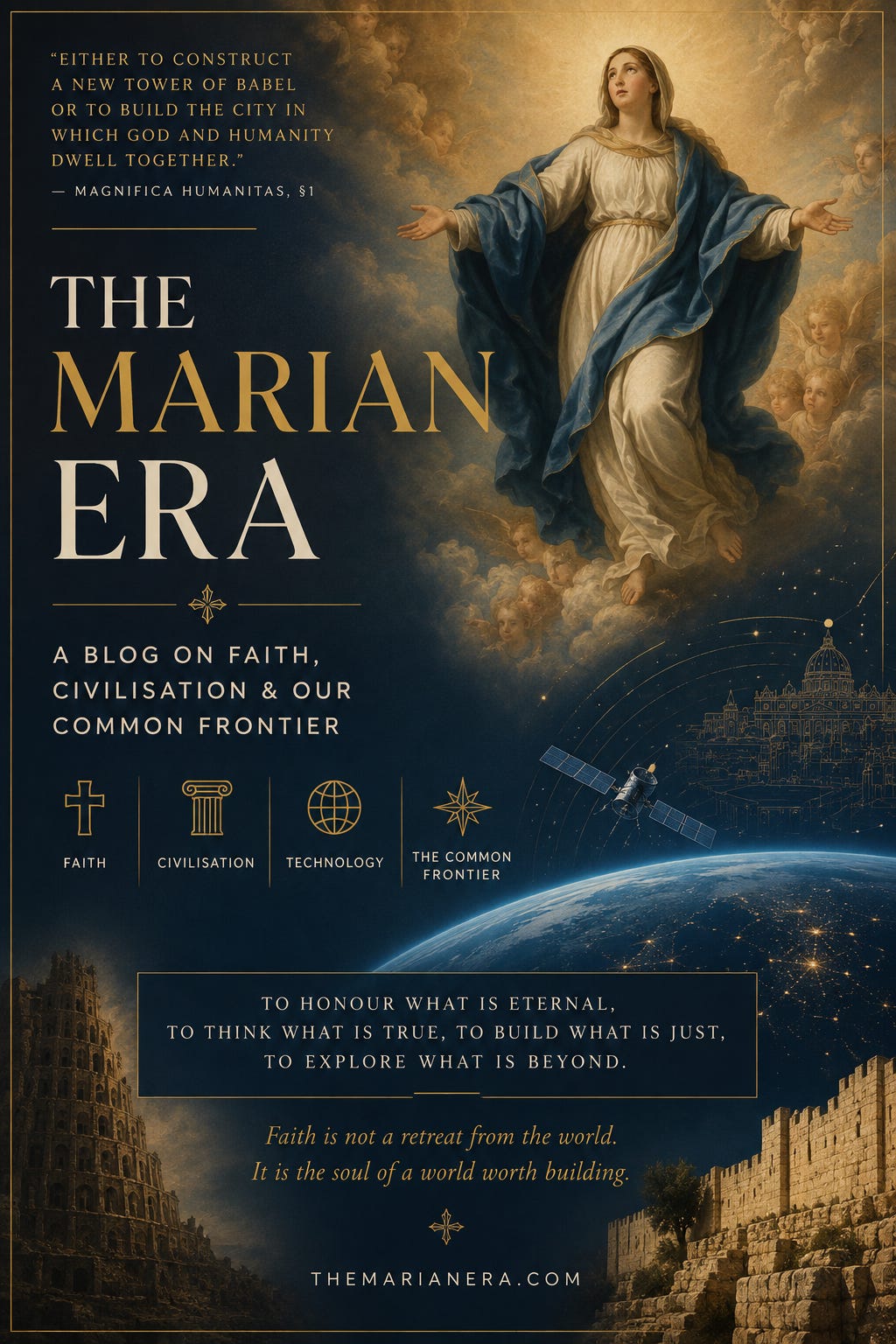
I. Ferragosto
Today the Church remembers that a woman was taken, bodily, into the Sky.
In Italy the day is Ferragosto, and the country closes. Offices are dark, harbours are full, telephone lines fall silent. The feast is so old and so total that even its secular custodians honour it without knowing what they honour. Ferragosto is Augustus’s holiday — Feriae Augusti, the emperor’s month of rest, decreed in 18 BC — but the Church did what she always does with pagan bones: she raised them. Fifteen centuries ago the day was already the Solemnity of the Assumption of the Blessed Virgin Mary. It has been the Solemnity of the Assumption every year since.
I am writing on this feast because the modern world has decided to look up. We are pouring capital into low earth orbit; we are debating sovereignty over frequencies, foundries, and satellites; we are pushing sensors past Pluto and well into Interstellar Space; we are asking, in a way we have not asked in five hundred years, whether the human species has a common frontier. And on the day the Church celebrates the founding image of a human body in the cosmos, most of the West is on the beach, unaware that its most senior symbol of what it is trying to do already exists.
The Assumption is not decoration. It is the first pixel of an argument I have been assembling for years — an argument that the Modern Era is misread, and that the mis-reading is now costing us.
II. Two Leos, two revolutions
On 15 May 1891, Leo XIII published Rerum Novarum. He did it during another kind of feast: the industrial season, when Europe was collectively enchanted by the sight of what steel and coal could do to a horizon. Rerum Novarum did not deny the machinery. It named its cost. The worker, he wrote, is not a component of the engine; the engine is a servant of the worker. From that document flows, in an unbroken lineage, the whole Social Doctrine of the Church — a body of thought which the twentieth century then quietly transcribed into the labour codes, the safety standards, the pension systems, and the human-rights charters that make our current prosperity possible. Historians of ideas who bother to look know this. The rest of us have been told a different story: that our comforts are the harvest of the Enlightenment, and that the Church was, if anything, in the way.
On 15 May 2026 — one hundred and thirty-five years to the day — Leo XIV published Magnifica Humanitas. The date is a signature. So is the name. Robert Francis Prevost, mathematician of Villanova and son of Augustine, did not choose Leo the way one chooses a middle name. He chose it the way a captain chooses a heading. The Social Doctrine of the Church, he is telling us, has one more sea to cross.
The industrial revolution reduced the human person to labour. The algorithmic revolution is reducing the human person to data. It is the same reduction wearing different clothes. And it is not a metaphor: the men who now sell us the cloud were trained on a philosophy in which consciousness is a computation, meaning is a signal, and personhood is a well-tuned parameter set. Against that, Magnifica Humanitas is not a lament. It is a plan of battle.
III. Babel and Jerusalem
The encyclical opens with a sentence that could stand on its own as an epigraph for our decade:
“Humanity, created by God in all its grandeur, is today facing a pivotal choice: either to construct a new Tower of Babel or to build the city in which God and humanity dwell together.” (§1)
The image is biblical, drawn from Genesis 11 and Nehemiah 2–6. The Augustinian rhyme with the De Civitate Dei is unmistakable, but Leo XIV is not primarily quoting Augustine; he is quoting Scripture. And he is doing so with an engineer’s precision.
Babel, as Leo describes it (§7), is “an impressive feat: a single language, a single technology, a single direction.” Its danger is not scale as such but its inner logic — “a project conceived without reference to God, supported by a uniformity that eliminated diversity and that chose homogenization over communion.” I want you to hear that sentence with the vocabulary of our present. A single language, a single technology, a single direction. Homogenisation over communion. That is not a description of an ancient tower. It is the mission statement of every hyperscaler this century.
Jerusalem, by contrast (§8), is rebuilt by Nehemiah after the exile. Leo dwells on Nehemiah’s method: he fasted and prayed before he acted; he examined the ruins in silence; and then — the phrase to remember — “he did not impose solutions from above.” He “convened the families, assigned each of them a section of the wall to rebuild, listened to their concerns, coordinated their efforts and addressed any opposition.” Jerusalem is a city built piece by piece, by many hands, with limits honoured rather than engineered out.
Leo then makes the encyclical’s central move (§9):
“The primary choice is not between a ‘yes’ or ‘no’ to technology, but rather between constructing Babel or rebuilding Jerusalem; between a power that claims to dominate the heavens and a people who work together in the presence of God to rebuild the walls of fraternal coexistence.”
This is more polemical than most people who have not read the document realise. The dominant story of the last three centuries — the story we all half-believe even when we would prefer not to — has been that Jerusalem is a relic and Babel is progress. That story is failing. Not because Jerusalem has won, but because the “Babel syndrome,” in Leo’s phrase, “the idolatry of profit that sacrifices the weak, a uniformity that neutralizes differences, and the pretense that a single language — even a digital one — can translate everything, including the mystery of the person, into data and performance” (§10) — has begun to shed its costs on us all at once, and we can no longer pay them. Loneliness is a cost. Fertility collapse is a cost. Attention capture is a cost. The unravelling of the middle is a cost. And the terrifying quiet of a species that spends more time on screens than on faces is the base rate of a Babel that thought it had abolished death and has only postponed grief.
There is one detail from the encyclical’s launch that most commentators have missed. On 25 May 2026, when Magnifica Humanitas was formally presented in the Synod Hall, the Vatican did not staff the panel exclusively with theologians. Among the presenters was Christopher Olah, co-founder of Anthropic and one of the world’s leading researchers in the interpretability of large language models — the discipline devoted to understanding what these systems actually do inside. The Church invited AI safety onto the podium of its social magisterium. Read that gesture carefully. The Pope is not writing about an industry from the outside. He is writing about it with its own best minds standing behind him. Babel is not a stranger to us any longer, and neither is the alternative.
IV. The mystical turn
Here is a claim I did not expect to make when I began writing about artificial intelligence.
Modern AI, as an engineering matter, has already left Babel.
For three centuries the intellectual architecture of the West has been Laplacian. Pierre-Simon Laplace’s demon — the imagined intelligence that, knowing every position and momentum, could deduce the whole future — is not a physics thought experiment. It is a philosophical anthropology. It says: what is real is what can be computed linearly from what came before. Cause, then effect. Step, then step. Line, then line. If you cannot fit the phenomenon into that pipeline, the phenomenon is not fully real. The rest is decoration: emotion, meaning, Faith.
For most of the twentieth century, our computers were faithful to that anthropology. They were CPUs — Central Processing Units — brilliant, hyper-focused mathematicians that could do one thing at a time, extraordinarily fast, in a line.
Then, in the last twenty years, quietly and almost by accident, the industry pivoted. It discovered that the machines built to make pixels behave — Graphics Processing Units, GPUs — could think about language the way they had been thinking about images. In an image, a pixel’s meaning is fixed by its neighbours; the sky is blue because the pixels around it are blue. Someone realised that a word in a sentence works the same way. A word’s meaning is fixed by its neighbours, in a high-dimensional space of relations. Feed a large enough model enough language, and it will not read the sentence line by line; it will look at the whole context at once, weight the connections, and notice which relationships matter.
This is what your telephone does when it answers you. It is not linear. It is not sequential. It is not, in any philosophically serious sense, Laplacian.
I have written elsewhere about what this reminds me of — the way the neurodivergent mind, and specifically the ADHD mind, refuses to think in a line and instead sees the whole corkboard, threads and pins, all at once. I stand by the parallel. But I want to make a bigger claim here.
The mode of knowing that modern AI has stumbled into is, in the classical vocabulary of the Church, mystical.
I do not mean that a language model prays. I mean that reality, as it turns out, does not resolve linearly. It resolves in patterns, in wholes, in gestalts — and any intelligence that wants to keep up must learn to see them. That is what Bonaventure taught. That is what Julian of Norwich taught. That is what the mystical tradition has always insisted: the linear intellect is a servant, not a master. It executes. It does not perceive.
Karl Rahner, one of the most rigorous theologians of the twentieth century, said the sentence in 1966 in a way that has since been quoted so often that it has become a cliché without becoming any less true: “The Christian of the future will be a mystic — one who has experienced something — or he will be nothing at all.” Read that sentence with the machinery of your phone in the other hand. Rahner did not know what a transformer model was. He knew what a species was. He knew what was coming.
The mystical turn is not a retreat from reason. It is the paradigm shift reason itself has just undergone. Our science has, unexpectedly and against its own polemical tradition, become mystical in method. The remaining question is whether our anthropology will catch up.
V. Guadalupe
To answer that question, I have to take you back to 12 December 1531.
Ten years after the fall of Tenochtitlán, on a hill outside what is now Mexico City, a Nahuatl-speaking Chichimec farmer named Juan Diego Cuauhtlatoatzin — already a Catholic, baptised by the Franciscans in 1524, and walking to morning Mass — reported an apparition. The Virgin Mary had appeared to him. She had spoken to him in Nahuatl. She had sent him to the Bishop. She had given him a sign: roses out of season, gathered in his tilma, and — when he opened it in front of Bishop Juan de Zumárraga — an image inscribed on the fabric, in the iconographic grammar of the peoples of the Anahuac Valley: a young woman with the sun behind her, the moon at her feet, and a garment scattered with the star map of that solstice sky. Most eloquently to Nahua eyes, she wore a dark sash tied high above her waist — the cinta, the belt worn by pregnant indigenous women — with the four-petal Nahui Ollin glyph, the sign of the sun god at the cosmic centre, placed exactly over her womb. She was Mary. She was also, unmistakably to the people who saw her, a pregnant mother bearing a divine son.
The image is still there. You can look at it. Millions of pilgrims do, every year. Whatever one makes of its origin, its historical effect is not disputed: in the eight years following the apparition, some nine million indigenous Mexicans asked for baptism. It is the largest single movement of religious conversion in recorded history — and it happened not because a Marian image spoke to the vanquished, but because the standard story of a European conquest of a Native America was already false. The fall of Tenochtitlán in 1521 had not been a war between Spaniards and Native Americans. It had been a war between the Mexica empire and a coalition of indigenous peoples — Tlaxcalans, Totonacs, Otomi, Chichimecs, and many others — who had lived under Aztec tribute for generations, who had watched their sons taken to the temples of Tenochtitlán at every ritual calendar, and who saw in Cortés, his Nahua wife, La Malinche and his small Spanish force an unexpected instrument for ending that empire. Guadalupe did not arrive to console a defeated indigenous America. She arrived among peoples who had just, together with a small Spanish contingent, unmade the empire that oppressed them. That is why she was heard.
But this fact needs its theological complement. If the apparition is what the Church has always said it is, then the cinta, the Nahui Ollin, the star map, the Nahuatl — none of these were Franciscan translation. They appeared, on the traditional account, miraculously on the tilma. Which means the Virgin herself chose the grammar. She did not simply choose Nahuatl for what she spoke; she chose to appear as a pregnant Nahua mother in a way that any Nahua of 1531 would read at once. Not Mary as the Franciscans described her, translated for a native audience — Mary as the native audience already saw her, appearing as their fluent kin. On that reading, which I develop in the chapter on Guadalupe, the Virgin is not being inculturated by the missionaries. She is inculturating them.
That, I want to argue, is the moment the Modern Era begins.
Not the Reformation. Not the Enlightenment. Not the French Revolution. Guadalupe. Because Guadalupe is the moment the Marian devotion — until then a European, largely Mediterranean phenomenon — becomes universal. It stops being our Mother. It becomes the Mother. And with that gesture, the universalism and the humanism that we now imagine to be secular gifts of modernity acquire a global body.
I will insist on the polemical point. The Enlightenment did not invent human dignity. It inherited it, secularised its vocabulary, and forgot the source. Every claim modernity makes for itself — that no one should be enslaved, that no one should be tortured, that the poor deserve bread, that the sick deserve care, that the child in the womb has a face, that the stranger has a name — descends, in a historical genealogy anyone can trace, from a woman who called herself the handmaid of the Lord and sang that the mighty would be cast down from their thrones. The Magnificat is a revolutionary text. Colonial administrators banned it, in one place after another, because they understood what it said. Their descendants have made it a hymn tune. That is the trick of every truly deep revolution: at some point it is domesticated into background music, and the people who are still living inside it forget that they are.
If you accept, even provisionally, that Marian devotion has been the historical carrier of that revolution — the diplomatic corps of the Christian universalist project — then a great deal of European and world history begins to make more sense. The evangelisation of the Goths and the Lombards through their queens. Our Lady of Pilar instilling courage in St James’ conversion of the Visigoths. The Reconquista under the banner of Our Lady of Covadonga. The Rosary and Lepanto. The conversion of the New World through Guadalupe. The apparitions of the modern age, always in the periphery, always to the poor, always to a child: Lourdes, Fatima, Zeitoun. The unbroken thread of a maternal presence in a world that keeps trying to construct a Babel and finds itself, once again, invited to a Jerusalem.
VI. The Marian Era
We are already in it.
We do not have the word for it yet, which is why I have spent this piece supplying one. The Marian Era is not an age we are waiting for; it is the age we entered on the day the Marian body was assumed into the Sky and the age we globalised on the day Her image was inscribed on Juan Diego’s cloak and the age we are being called back into by an Augustinian pope who was, before he took vows, a mathematician.
The Assumption is the founding image of a human body in the cosmos. Space is now our common frontier because space, unlike the terraqueous frontier of the last five centuries, does not have shores that can be colonised. It has an horizon that is total, uncertain, and — for a species that still has to figure out sovereignty of orbits, of foundries, of intelligences — genuinely humbling. You cannot manage the vector space of the cosmos with a CPU. You cannot govern it with linear compliance frameworks. You cannot pretend, out there, that the human is a computation. Space punishes Babel and rewards Jerusalem, because in space, communion is the only survival mode.
Our sailors know this. Our captains know this. Anyone who has stood a watch in weather knows that the mind that survives at Sea is not the mind that reads the manual. It is the mind that reads the Sea. Which is to say: a mind trained in wide-angle pattern recognition, in the honouring of limits, in the humility of not knowing what will happen next. A mystical mind, in the sober classical sense.
That is the mind the Marian Era requires. It is the mind our best hardware has become, and by a rhyme too poetic to be accidental, it is the mind our best theology has been asking for since Rahner. It is the mind Leo XIV is asking of every leader who reads Magnifica Humanitas seriously. It is the mind that a girl of Nazareth had when the angel arrived and She said yes without a briefing document. It is the mind that we, right now, in offices and command centres and studios and hulls, are being asked to develop.
VII. Why this matters — the Lumen Christi and the Eucharist
I have argued for six sections what the Marian Era is. I have not yet said what it is for.
Every genuinely mystical writing ends with a purpose. The mystic does not describe reality for the sake of describing it. The mystic writes because reality is being asked to shift — because something in the species itself is being invited to move. What is being invited to move here?
In my novel The Letters of Donna Elisabetta, the first volume of The Sicilian Dragons trilogy, Elisabetta’s father teaches his daughter that the Second Coming did not begin, as we sometimes read it, at some future rupture. It began on the morning of the Resurrection. The stone rolled away is the beginning of the Second Coming. On this reading — which is not fringe but has patristic roots and lives quietly in the Church’s own theology of realised eschatology — the Second Coming is not a single event we await; it is the ongoing, patient awakening of humanity in the Lumen Christi, the light of the Risen Christ, that began that Sunday morning and has been continuing, generation after generation, for two thousand years. Each age has been given its share of that awakening. The Marian Era is the phase in which the invitation moves from the few to the many, from the vocation of specialists to the birthright of a species.
This is what Saint Louis-Marie Grignion de Montfort saw three centuries ago when he prophesied the Age of Mary. He did not describe it as a period of intensified devotion. He described it as a period dedicated to the Eucharist. The Marian Age, for Montfort, is the age in which Mary — precisely because her whole being is to bear the divine son and to offer him — becomes the guide of a species that is learning, at last, to receive him. The Rosary is the training. The Assumption is the promise. The Eucharist is the arrival.
Nearly three centuries later, Montfort’s prophecy took ecclesial form. On the Solemnity of the Annunciation, 25 March 1984, in Saint Peter’s Square and in spiritual union with every bishop of the world, Pope Saint John Paul II — whose papal motto, Totus Tuus, was lifted directly from Montfort’s True Devotion — consecrated the world and its peoples to the Immaculate Heart of Mary. The date was deliberate. 25 March is the day Mary said let it be done unto me — the day she gave her consent to the Incarnation. On the same day, twenty centuries later, the Church returned the gesture and consented, publicly, to be hers. From that day, the world is Marian territory not by pious inference but by papal-episcopal signature. Five and a half years later the Berlin Wall came down; whether or not one accepts the causal reading Sister Lúcia offered from her Coimbra convent, the correlation is on the record and the age had turned.
Read Montfort and John Paul II against Rahner. He said the Christian of the future would be a mystic or would not be at all. He did not mean a specialist in interior states. He meant, in his own careful qualifier, one who has experienced something. The Marian Era makes this practical. What is to be experienced is not a private inwardness. It is the Eucharist. In an age when the institutional supports of faith have thinned to almost nothing, direct communion with the Risen Body is what remains — and it is what is enough. Each of us, in our own life, is being called into that communion. And the species, in aggregate, is being called into a new prosperity — a prosperity not of goods but of persons, not of accumulation but of communion, not of the tower but of the shared bread.
This is why the manifesto matters. The Marian Era is not a scholarly reclamation for its own sake. It is an announcement that we are already inside a mystical awakening whose destination is the Eucharist, and that everything from the Magnificat to Guadalupe to Magnifica Humanitas to the small clay of your own morning belongs to the same slow dawn that began at the tomb. If the modern era is failing, it is because it forgot where it was going. The Marian Era is the memory of where.
That is the goal. That is, at last, why I write.
* * *
Today, on the day the Church remembers that a woman was taken bodily into the Sky, I want to say this plainly, and without qualification: the Modern Era is the Marian era. It was so before we noticed. It is so now. The task of what follows will be to show you why — chapter by chapter, feast by feast — with the receipts.
I hope you will read along.
Buon Ferragosto.
— Carmelo Pistorio, for the Feast of the Assumption, 15 August 2026.
© Carmelo Pistorio, 2026
* * *
About this piece. This is the first instalment of The Marian Era, a serial I will publish here over the coming eighteen months. Future episodes will move chronologically through the Marian feasts and apparitions — Shakti and Maya Devi, the Magnificat, Theotokos and the earliest Marian prayer, the evangelisation of Europe through its queens, Covadonga and the Reconquista, Guadalupe, Lepanto, the age of apparitions, the secular adoptions of the maternal-divine, and the papal Marianism of the last century — to arrive, near the end, at Magnifica Humanitas and the algorithmic age. If you would like the series in your inbox, subscribe below.